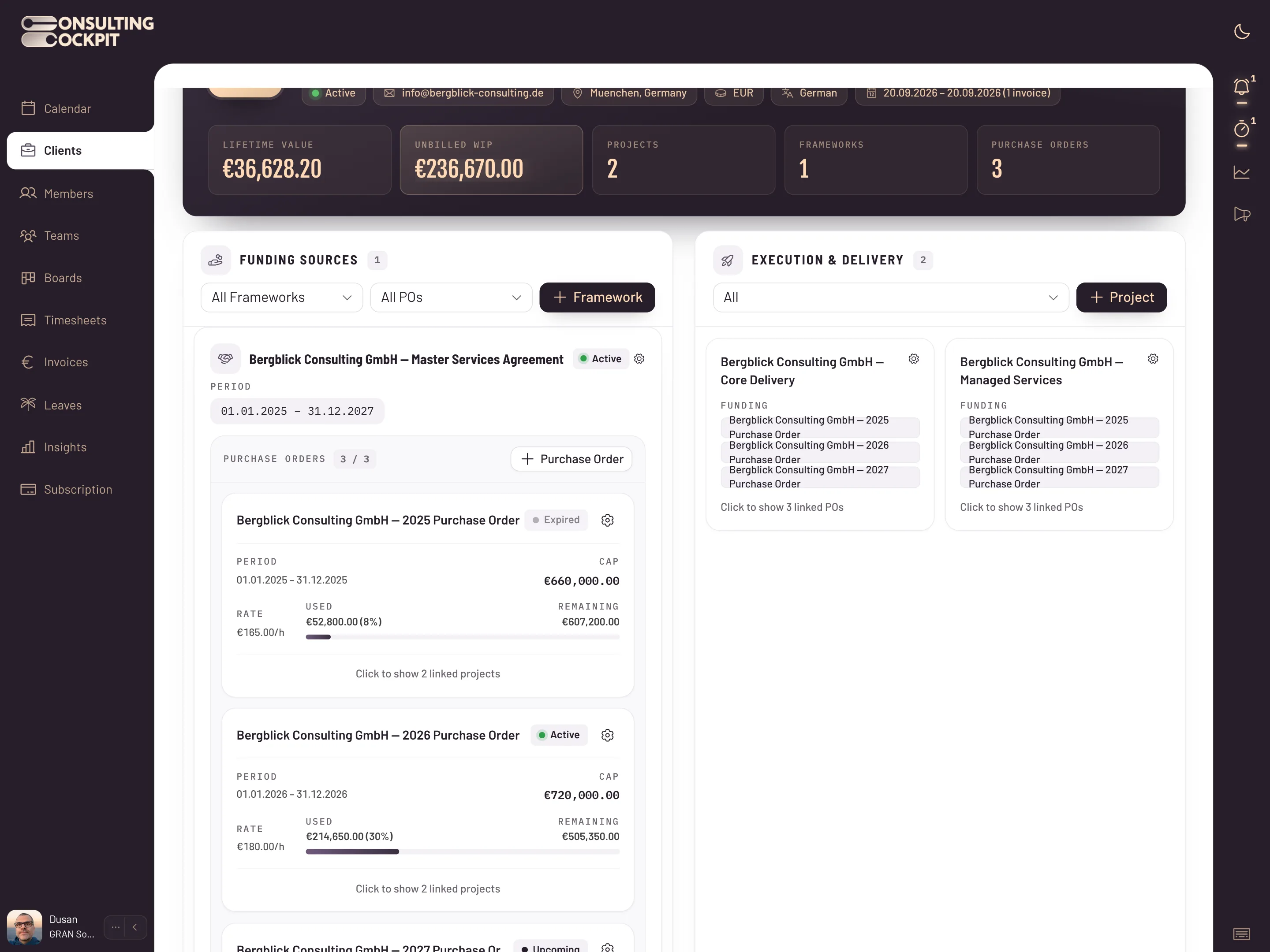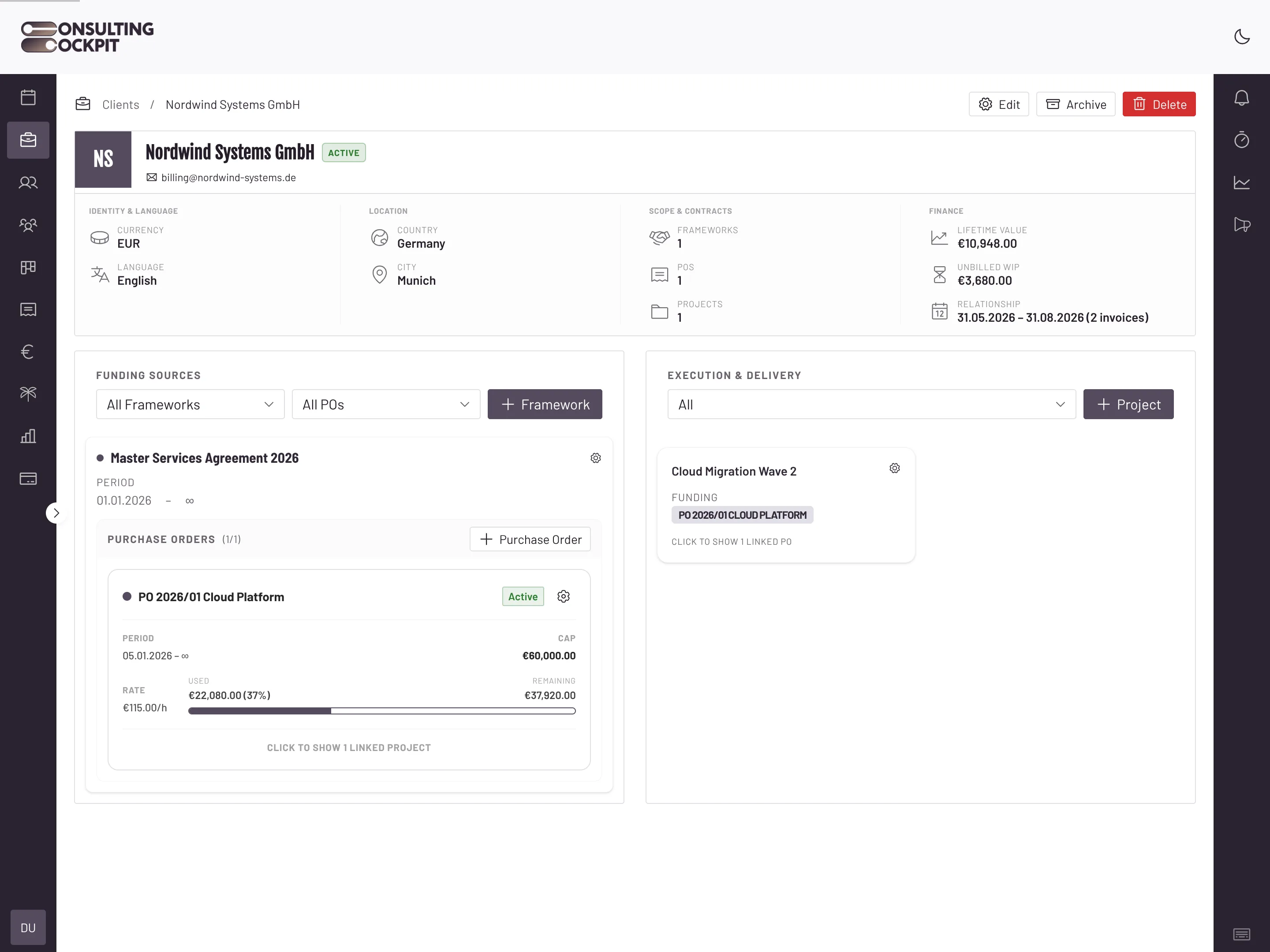
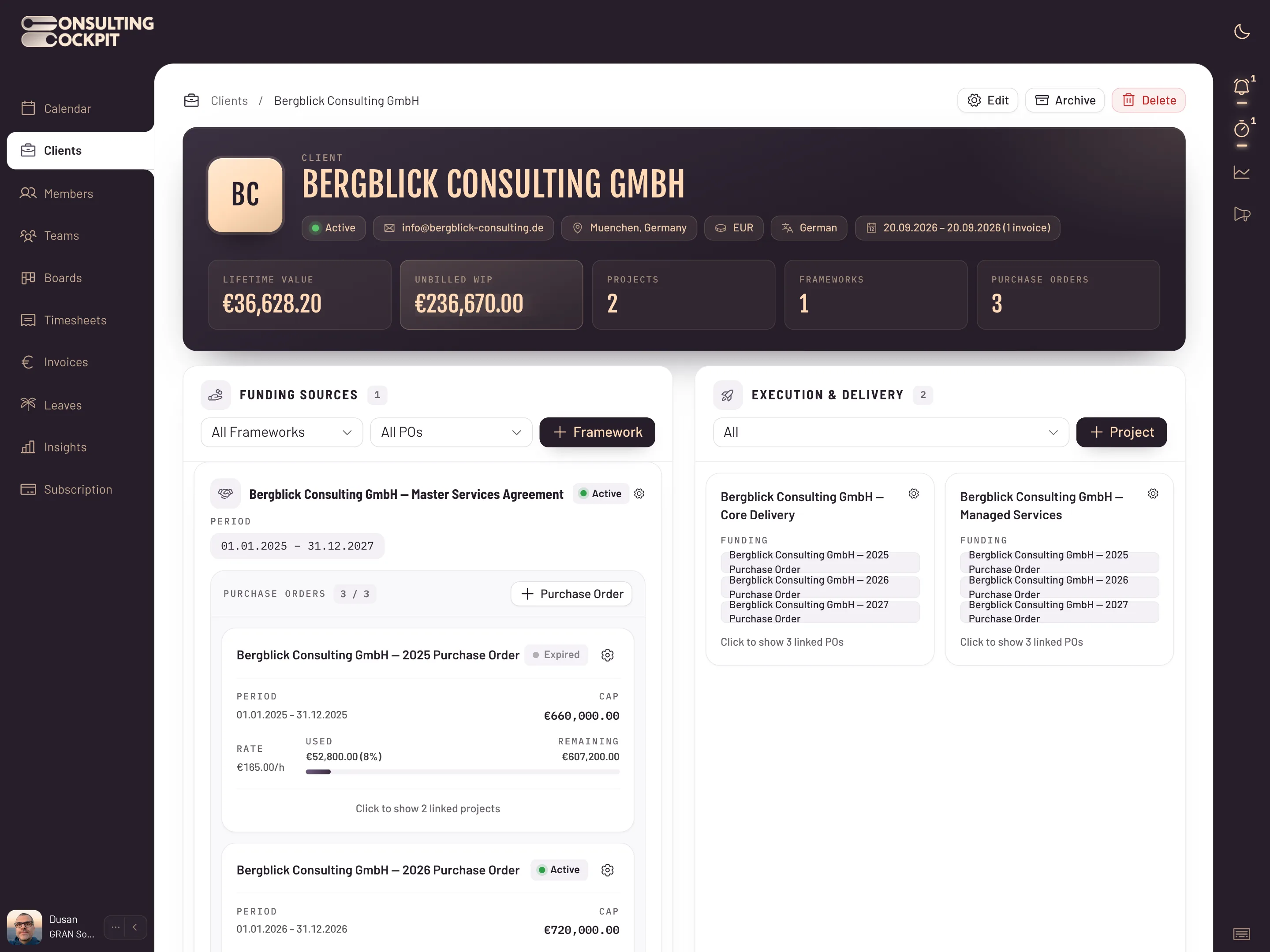
Your contracts live in the tool the way your client signed them — a framework agreement per client, with individual purchase orders underneath, each carrying its own rate, period and budget.
Most tools allow a single hourly rate per client, so the second purchase order at a different rate has to be tracked by hand.
Periods and budgets sit in a PDF folder, so hours get logged against a purchase order that ran out weeks ago.
A client cancels a purchase order mid-quarter and the hours keep landing on it until someone notices at invoicing.
Payment notes and early-payment discounts agreed once in the framework contract get copied into each invoice by hand.
A framework agreement per client, purchase orders underneath it, and every logged hour landing on the right one.
One agreement per client with a start date, an end date and the commercial terms you negotiated. Change it or remove it whenever the contract changes.
Each purchase order gets its own name and number, its own period, its own hourly rate and its own budget cap. Three orders at three rates under one client is normal, not a workaround. A grid on the client page shows which orders fund which projects.
Logged time is matched to the purchase order that covers the date it was worked, so the correct rate applies without anyone choosing it from a list.
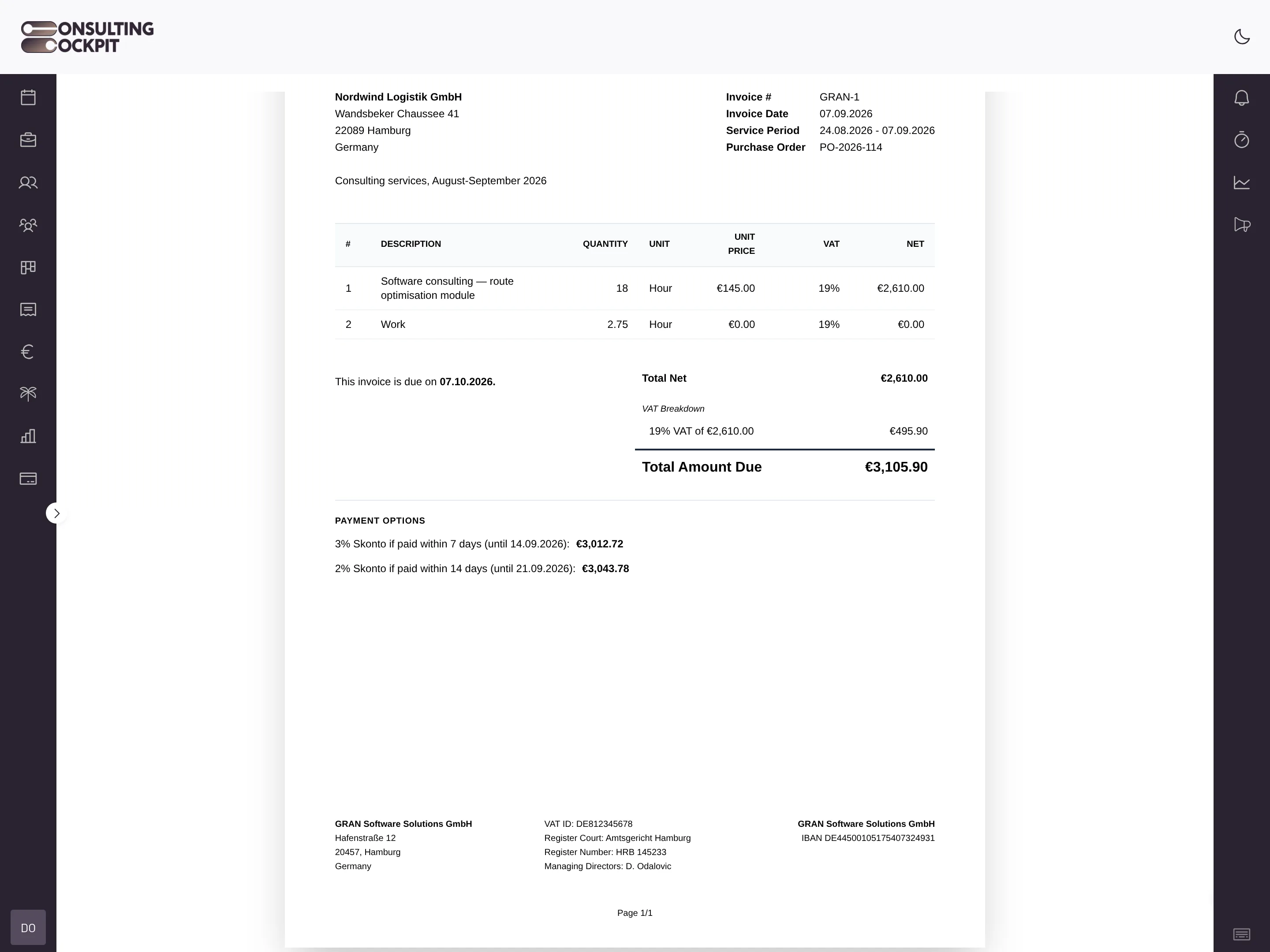
The invoice notes and early-payment discount terms you set on the agreement appear on every invoice raised under it. Agree them once.
Contract reality is messier than a start and an end date. These are handled.
When a purchase order is cancelled, it stays usable strictly before the cancellation date and stops taking hours from that date onward.
Two purchase orders running in parallel under the same agreement each keep their own rate, period and budget. Neither one absorbs the other's hours.
An extension is a new purchase order under the existing framework agreement — the client relationship and its terms stay intact.
Every purchase order carries its own budget cap, the Skonto agreed here is priced onto every invoice that follows, and the agreement sits on the client's record, see Budget Tracking , Early Payment Discounts and Client Management
Real screens from the product — swipe or use the arrows.
The framework agreement is the umbrella contract with the client — the relationship, the period and the commercial terms. A purchase order is a single call-off under it, with its own rate, period and budget.
It is a purchase order issued under an existing framework agreement rather than as a standalone contract. In Consulting Cockpit it hangs off the agreement and inherits its invoice terms while keeping its own rate and cap.
Yes. Each purchase order carries its own hourly rate, so a senior architect order and a delivery order can run in parallel under one framework agreement.
You record the cancellation date, and the order remains usable strictly before that date. Hours worked from the cancellation date onward will not be matched to it.
Yes — that is exactly the structure: one Rahmenvertrag per client with individual Abrufaufträge underneath, each with its own Tagessatz or hourly rate, period and Projektbudget.
Yes. Invoice notes and early-payment discount terms sit on the framework agreement and flow into every invoice raised under it.
Set up your framework agreements and purchase orders in an afternoon, and let every logged hour find its own rate. Free for 30 days.